Down syndrome is a chromosomal condition caused by an extra copy of chromosome 21 that affects physical and cognitive development. It occurs across all populations and backgrounds and is among the most commonly identified chromosomal conditions worldwide.1
For families receiving a diagnosis, the quality of explanation they receive early on matters. Clear clinical understanding helps parents make sense of the condition and prepares them for the medical care and developmental support that may follow.
This article explains what Down syndrome is, why it happens, its clinical features, and how it is detected using advanced prenatal screening tests before and after birth .
What Is Down Syndrome?
Down syndrome is more common than most people realise. Humans typically carry 46 chromosomes in 23 pairs. In individuals with Down syndrome, a third copy of chromosome 21 is present, making it 47 chromosomes.2
That extra genetic material changes how the brain and body develop from the very start. That difference, the one extra chromosome, is what we refer to as Down syndrome.
Down syndrome occurs in three chromosomal variations.
- Standard Trisomy 21, caused by a process called nondisjunction during meiosis, accounts for roughly 95% of cases and is present in every cell of the body.2
- Translocation Down syndrome involves chromosome 21 material attaching to another chromosome.
- Mosaic Down syndrome is the rarest variation. Only some cells carry the extra chromosome while others remain typical, which is why the condition may sometimes be diagnosed later.2
Down Syndrome Clinical Features
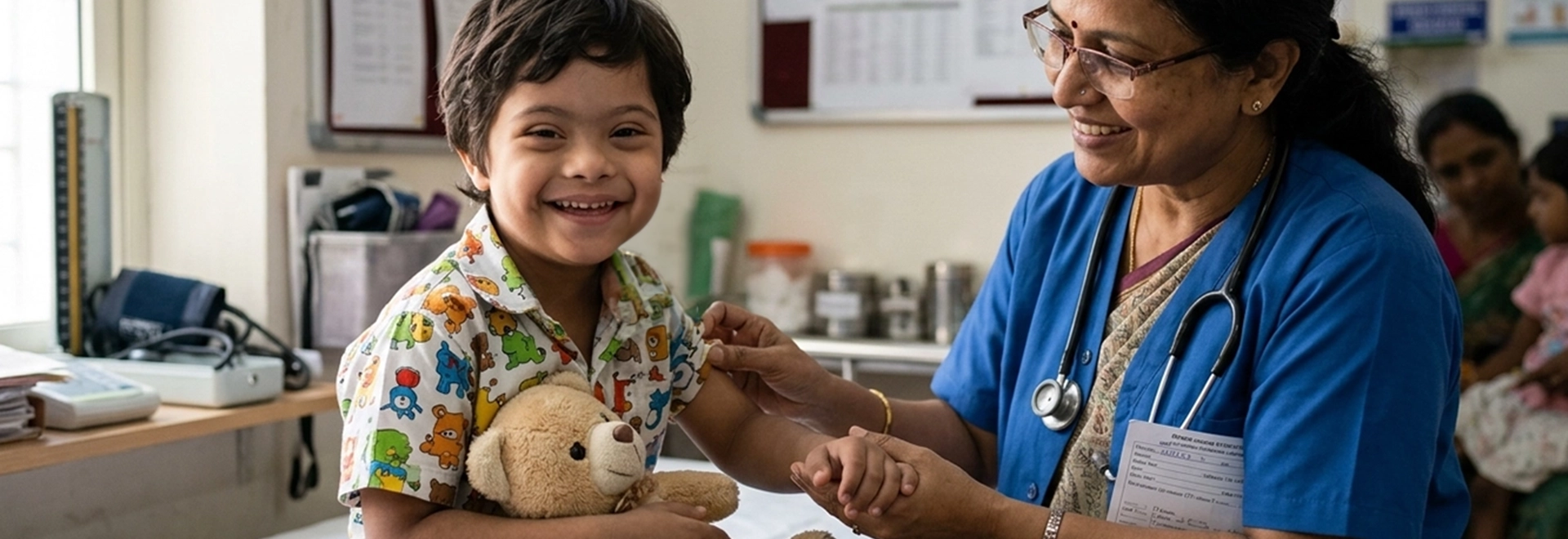
Most clinicians can identify Down syndrome just by looking at the child. However, knowing specific signs helps ensure early care and support.2 Babies are usually born with low muscle tone.
Common facial features include a flat face, eyes that slant upward, skin folds near the inner corners of the eyes, and a larger-looking tongue. Other features may include a single line across the palm, a short and broad head, and short stature. Doctors must also watch for atlantoaxial instability, a neck joint problem that requires regular screening in childhood.
Systemically, around 40% to 50% of patients have congenital heart defects. When cardiac defects are present, atrioventricular and ventricular septal defects are the most common findings.4 Hypothyroidism is prevalent and needs regular monitoring throughout life.5
Gastrointestinal anomalies, hearing loss, and vision impairments all require structured, ongoing follow-up rather than one-off assessments. No two individuals present the same way, which is why personalised care and early intervention are required.
Why Down Syndrome Happens
Down syndrome is a genetic condition that typically occurs randomly during the formation of reproductive cells. In most cases, a separation error called nondisjunction happens in the maternal egg during meiosis.
Instead of the chromosomes dividing evenly, the egg carries 2 copies of chromosome 21.6 When fertilised by a typical sperm, the resulting embryo develops with 3 copies, a state known as trisomy.²
The Impact of “The Extra Copy”
It is important to understand that the extra chromosome 21 is not “damaged” or “abnormal” in itself. It simply introduces additional genetic material that the body was not designed to balance.²
Because these genes are expressed at higher levels than typical, this overexpression disrupts the development of the brain, heart, and other organs starting early in fetal life.7 This systemic disruption explains 2 key aspects of the condition:
- Multi-system involvement: Because gene expression is altered throughout the body, the condition affects multiple organs rather than just one.
- Individual variation: Gene expression does not behave identically in every person. This is why two individuals with the same trisomy can present with very different symptoms and abilities.
Relieving Parental Guilt
Families almost always ask: “Why did this happen?” In the vast majority of cases, Down syndrome is a random event. There is no environmental trigger, lifestyle factor, or specific action taken during pregnancy that causes it. Highlighting this biological randomness is essential to help relieve the unnecessary guilt that many parents experience.6
What Does Down Syndrome Do to Development?
The third chromosome 21 brings extra genes with it. Those genes are overexpressed, and the impact on brain development begins well before birth. Synaptic density, myelination, and cardiac morphogenesis are all affected.
The result is a characteristic but variable profile of cognitive and physical differences. Early therapeutic input consistently improves outcomes, and the gap between early and late intervention shows up clearly over time.
Why Down Syndrome Happens During Pregnancy?
While Down syndrome is identified while a person is pregnant, the biological event itself precedes the pregnancy’s progression. The presence of the extra 21st chromosome is established during the initial formation of the embryo.
Therefore, pregnancy serves as the period of manifestation and detection rather than the cause of the condition. Medical assessments during this time are designed to identify these existing chromosomal arrangements,
Does Down Syndrome Run in Families?
For the majority of cases involving Standard Trisomy 21, the answer is no. This variation occurs as a random, spontaneous chromosomal event during the formation of reproductive cells, meaning the recurrence risk is typically only slightly higher than the age-related baseline.
However, translocation Down syndrome is different. This specific type can be passed down from a parent who carries “balanced” rearranged genetic material. When a translocation type is confirmed, medical guidelines recommend parental karyotyping to determine if there is a hereditary link and to provide accurate guidance for future pregnancies.3
How Down Syndrome Is Detected?
Detection can begin as early as 10 weeks of pregnancy. Most antenatal screening programme typically utilises first-trimester combined screening to identify the majority of cases.8 While Non-Invasive Prenatal Testing (NIPT) using cell-free fetal DNA (cfDNA) significantly improves screening accuracy and provides early clarity for families , it remains a screening tool rather than a definitive diagnosis.5
For families navigating these results, MedGenome offers specialised genetic services, including the Claria NIPT for early screening and comprehensive Chromosomal Microarray (CMA) for detailed diagnostic insights. By providing precise genomic data and expert genetic counselling, MedGenome helps move from screening suspicion to a clear, clinical understanding of chromosomal findings, ensuring informed decision-making at every stage.
Frequently Asked Questions (FAQs)
- Is Down syndrome a genetic condition or a hereditary disorder?
Down syndrome is genetic but rarely hereditary. Most cases (Trisomy 21) result from a spontaneous chromosomal error at conception. Only Translocation Down syndrome, which accounts for a small percentage of cases, can be inherited from a carrier parent.
- Can Down syndrome be prevented during pregnancy?
No. The chromosomal difference occurs at the moment of conception. There are no environmental factors, lifestyle choices, or medical interventions during pregnancy that can cause or prevent the condition.
- Are clinical features the same in all individuals?
No. While the presence of the extra chromosome is the same, gene expression varies. Physical features and medical complexities differ significantly between individuals, meaning each person requires a personalised approach to care and support.
- At what stage of pregnancy can Down syndrome be detected?
Screening via cell-free fetal DNA can begin at 10 weeks. Diagnostic confirmation is available through Chorionic Villus Sampling (CVS) between 10-13 weeks or amniocentesis from 16 weeks onward. The right choice depends on gestational age and patient preference.
- Does family history increase the risk?
Generally, no. For standard Trisomy 21, the risk does not typically run in families. However, if a parent carries a balanced translocation, the risk of recurrence is higher, making genetic counselling essential for those families.
References
- World Health Organization. Congenital Disorders. World Health Organization. Updated September 2023.
https://www.who.int/news-room/fact-sheets/detail/birth-defects
- Centers for Disease Control and Prevention, “Facts about Down Syndrome,” Birth Defects, last modified May 15, 2024,
https://www.cdc.gov/birth-defects/about/down-syndrome.html
- National Human Genome Research Institute, “About Down Syndrome,” last modified June 13, 2024, https://www.genome.gov/Genetic-Disorders/Down-Syndrome.
- Giang, Kok Wai, Mikael Dellborg, and Maria Fedchenko. “Impact of Down Syndrome on Survival Among Patients With Congenital Heart Disease.” Journal of the American Heart Association 13, no. 2 (January 12, 2024).
https://www.ahajournals.org/doi/10.1161/JAHA.123.031392
- Bull MJ; Committee on Genetics. Health supervision for children with Down syndrome. Pediatrics. 2022;149(5).
https://publications.aap.org/pediatrics/article/149/5/e2022057010/186778/Health-Supervision-for-Children-and-Adolescents?autologincheck=redirected
- National Library of Medicine, “Down Syndrome,” MedlinePlus, last modified April 12, 2022,
https://medlineplus.gov/downsyndrome.html
- Donovan, Micah G., Neetha P. Eduthan, and Joaquin M. Espinosa. “Variegated Overexpression of Chromosome 21 Genes Reveals Molecular and Immune Subtypes of Down Syndrome.” Nature Communications 15 (June 28, 2024).
https://www.nature.com/articles/s41467-024-49781-1
- National Health Service, “Screening for Down’s, Edwards’ and Patau’s Syndrome,” Your Pregnancy Care, last modified March 27, 2024, https://www.nhs.uk/pregnancy/your-pregnancy-care/screening-for-downs-edwards-pataus-syndrome/.