
Genetic Testing for a Healthier Tomorrow

Why Test?

Genetic testing has made precision care a reality. We no longer need to rely on a one size fits all approach to treatment. Your medical care can be designed based on your genetic profile to improve the chances of better impact and effective treatment. It’s another vital piece of information in your profile when your doctor chalks up a treatment plan.

Unlike lab tests that help you take stock of health indicators today, genetic testing is designed to identify future risks too. Given your family history and unique combination of genes, certain tests can help you get the right help well in time to cut your risk of adverse events including cardiac problems like heart attacks.
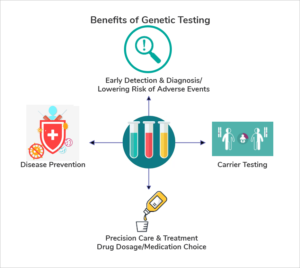
Genetic Testing for precision care and treatment

MedGenome Makes Genetic Testing Easy

When it comes to convenience, MedGenome has made it easier than ever to get a variety of genetic testing done. From ‘Claria’, a complete suite of reproductive testing solutions to ‘Prima’ for advanced oncology and solid tumors management, ‘Micra’ for infections diseases and their treatment, to ‘Actia’ which helps you with an accurate diagnosis of Rare Disease conditions, and more recently ‘Kardiogen’ from Genessense, a test designed to help identify your risk score for heart attacks. And all this without compromising the accuracy and efficiency of the tests themselves.

How Doctors and Genetic Counselors Can Help

Your doctor will be able to utilize the results of the genetic testing to help you work out treatment plans, identify drug resistance, predict the probable risk of illness or disease, and guide you on lifestyle changes and preventive care to help lower your health risks and keep certain conditions in check.

After any genetic test, individuals can benefit from speaking to either a doctor or a genetic counselor who can help interpret the results. While MedGenome tests are easy-to-understand, there are nuances that a counselor or doctor can help with. Plus, they’ll be better equipped to recommend a course of action by way of future tests, medication, and other preventive measures as needed.

This World DNA day, it’s time for all of us to take charge of our wellness, and leverage tools like these genetic tests that are at our disposal, for a healthier tomorrow.


Diabetes is a Growing Burden in the Society – Latest Scientific Advances Can Help Us Manage it Better

Genetics and Genetic Testing of Diabetes

About 2%-5% of diabetes have underlying genetic causes. An example of this kind of diabetes, is Maturity Onset Diabetes of the Young (MODY), a monogenic form of diabetes caused by mutations in the autosomal dominant gene that disrupt insulin production. MODY1 and MODY3 are the most common forms. In contrast, common forms of diabetes like Type 1 and Type 2 have genetic causes, but no distinct pattern of inheritance. They result from interactions of multiple gene variants (and are hence also called polygenic forms of diabetes), each exerting only a modest effect, and the environment. Hence the gene variants implicated in common forms of diabetes can be regarded more as susceptibility genes, and not disease genes per se9, highlighting the value of endocrine genetic testing in selected patients.

Predictive genetic testing for diabetes is now a reality. Babies with diabetes are now being immediately genetically tested for all implicated genes while previously they would only get genetic testing years after diabetes was diagnosed, after which the genes would be tested one at a time. Crucially, this means that the genetic diagnosis is made early, giving the doctor information on how best to treat the patient and inform them of the medical problems the patients are likely to develop in the future.

This is a paradigm shift in how genetic testing fits in with the patients’ clinical symptoms. In the past, symptoms were used to select which gene would be tested – now the early comprehensive gene testing means that the genetic result predicts clinical features that have not yet developed. This helps the doctors to anticipate the likely problems for their patients and put the appropriate care in place to reduce their impact10.

MedGenome’s Solutions

MedGenome, a provider of clinical genomics solutions for personalized healthcare, is committed to the development of comprehensive genetic diagnostic solutions. To this end, it has a genetic testing panel for MODY and neonatal diabetes, which tests for over 30 genes that are associated with the disease, such as ABCC8, AKT2, INS, and INSR. Early disease detection can enable better disease management thereby making a healthy lifestyle possible.

References

  1. https://www.diabetes.co.uk/diabetes-prevalence.html
  2. https://www.idf.org/diabetesatlas/update-2014
  3. Gale, Jason (November 7, 2010).”India’s Diabetes Epidemic Cuts Down Millions Who Escape Poverty”. Bloomberg.
  4. Diabetes can be controlled in 80 percent of Cases in India”. https://news.biharprabha.com/
  5. Indian Heart Association Why South Asians Facts Web. 30 April 2015. https://indianheartassociation.org/why-indians-why-south-asians/overview/

Gene Therapy: a promising potential treatment modality for LCA